Wednesday, November 30, 2011

Inouïe

Alright, this post is going to be a little different because it's going to be more about Paris and less about me. I know, I know, depressing...but still bear with me. Inouïe in french means "unheard of" or "unprecedented," and so the subject of this post is going to be some of the more rare or unheard of things to do in Paris that I've discovered. I think a lot of people come to Paris and see all the touristy stuff in a couple days -- the Louvre, Notre Dame, Eiffel Tower, etc. However, then those people come back and are like hmmm I wanna do something less touristy and have no idea where to even begin and so they go to like the Rodin Museum or whatever which (don't get me wrong it's a great museum) is still on the list of larger tourist attractions of Paris. So, I've decided that, having been here for a couple months now, I'm going to try and make a list of top-10 non-tourist things to do in Paris, so that next time you're in Paris or someone asks me to show them the "real" Paris, this list will come in handy. It's a good mix of museums, sites, experiences, and places to eat. Here goes...(also I'm trying out my best guidebook writing style, so no laughing)

1) Couscous at the Grand Mosque
This is a must-do. The largest mosque in Paris also has an amazing restaurant/café attached to it (so French, right?) and there's also a beautiful garden. For a very specific time during the day (I believe it's between 11 and 2) you can eat a meal at the restaurant, which is amazingly decorated with Arabic mosaics and full of couches and big round tables. Get either couscous or tagine, and don't forget to ask them to bring around the dessert platter...delicious North African treats await! For me, this is a prime example of something that's not french and yet so quintessentially Parisian. The Arabic community here is so large and present that eating good couscous has become something that all Parisians do, regardless of heritage.
A little taste of the cafe at the Grand Mosque.
2) Le Procope
This is the oldest café in Paris, and some might argue the world. It was opened in 1694 and Voltaire and Diderot used to frequent it often. It's on the Rue de l'Ancienne Comedie in the 6th arrondissement, and while the menu might be a bit pricey, it's worth it just to go in and have a coffee where Voltaire once did! One of the most magical parts of Paris for me is walking down the same streets that so many famous men and women have, and Le Procope is a prime example of one of those places that just oozes history.
3) Saint Sulpice
This is legitimately one of the weirdest looking churches I have ever seen. It's also located in the 6th, and not only is it just really cool to look at from the outside, but it's also pretty neat inside. It's only a little bit smaller than Notre Dame, and Charles Baudelaire and the Marquis de Sade were baptized inside it. Also, some of the paintings in the side chapels were done by Delacroix. Definitely a cool thing for the art and architecture fans.
Saint-Sulpice...what a crazy looking church!
4) Les Archives
The Archives of Paris are located in a Hotel Particulier (which is like an old urban mansion thing) which is incredibly designed and decorated. Not only that, but they also put up really awesome (free!) exhibits using materials from the archives which are, it goes without saying, incredible records and very well preserved. Even though the words will be in French, it's still neat for the non-French speakers to get as much as one can from the exhibit's visuals. Also, in walking through the building you can see facsimiles of some of the most important documents of French history like the Edict of Nantes and some letters written by Charlemagne.
5) Take a stroll around Montparnasse
I know I already wrote a post about the awesome-ness of Montparnasse, but it really is worth taking a walk around the neighborhood if you're looking for something to do. You can have a coffee at one of the four famous cafés (Le Dome, la Coupole, Le Rotonde, and Le Select) where Hemingway, Picasso, and many others used to go to daily. You can also go to the rue de Campagne Premier and see Man Ray's old studio and right across the Boulevard Raspail you can see Picasso's first studio. Also not to miss is the large sculpture sitting in the middle of the road on the Boulevard Raspail near the Boulevard de Montparnasse...it's a Rodin, Just sitting there, in the middle of the road. So if you REALLY need your Rodin fix...
The hotel where Man Ray and Kiki used to live on the rue Campagne Premier in Montparnasse
6) Watch the sun set from the top of the Centre Pompidou
To be fair, watching the sun set from anywhere in the world is usually a pretty cliched great experience,and the Centre Pompidou is a pretty great building, and so when you mix the two together..! Anyways, not only is this a great museum for art (and a very typical tourist attraction) but if you go to the top floor it presents one of the most amazing views in all of Paris. And when the sun is going down and the Eiffel Tower starts to sparkle...man...
7) Day trip to Chantilly
This is really worth doing if you're looking for an easy day trip from Paris. It's about 25 minutes on the train and you can see an amazing castle in an adorable town. 1000 times less touristy than Versailles, and I would argue just as pretty and easier to do in just one day. Also, the castle houses an amazing museum that has to stay on the premises (as dictated by some guy's will) and so there's three Raphaels and a bunch of other amazing things...definitely worth the trip!
The Chateau at Chantilly!
8) Eat a praluline from Pralus
Ok, I know all I talk about lately is this bread but seriously if you are in Paris YOU MUST TRY IT. It's a life-changing experience...the pink pralines...the hazelnuts...the butter...35 rue Rambuteau. I even have the address memorized. GO.
9) Rue Mouffetard
This is a great street behind the Pantheon that epitomizes a lot of what is great about Paris. There are markets and fromageries (cheese stores) and adorable restaurants and it's where a lot of locals go to shop. Getting stuff for a picnic there would be amazing...you can get a lot of stuff for cheap! Definitely a good way to eat some typically french bread and cheese.
10) Promenade Plantée
This is a little garden on top of some buildings in the 12th arrondissement. It goes for a couple kilometers, I think, and is a great way to get some green stuff into your day. It makes for a really pleasant walk or run and it's also neat to look down off the side and see Paris from a different angle. Also, it's just cool that there's a garden on top of some regular old buildings!
A picture (I did not take) of the Promenade Plantee. Neat, right?
 And so that concludes the list! The next time you're in Paris see if you can check out a couple of these things...I promise it will be worth your while! One of the best things about Paris is that it has so much to offer, from amazing world-renowned museums and sights to just everyday ordinary things that somehow become extraordinary when in this city.

Saturday, November 26, 2011

Accro

The term "accro" in French means "to be addicted to," and this post is going to be about all of the food that I am addicted to in France. First of all, I love food. And cooking, and baking, and meal time...everything that comes with food. In fact, I'm a bit of a snob when it comes to food, and more that a few friends have called me out on that in my day. But hey, I like eating well and I like being healthy and I like things that are delicious, sooo it's definitely not something I apologize for too often. Let me start off by saying that anyone who knows anything about food knows that French food is really good. However, I want to clarify a few things. A lot of people seem confused as to what actually constitutes French food. They have vague ideas of snails and French fries, but apart from that they are at a loss as to what a typical French meal would look like. My answer to whenever people ask me the question, "What exactly is French food?" is always, "Anything just done really well." And I think that's true! The French make amazing hamburgers, salads, sandwiches, fish...vegetables...everything! I believe that the heart of what makes French food so good is that it is prepared with fresh ingredients that are 100% real -- none of this I can't believe it's not butter nonsense or skim milk -- the French are gonna put real cream and real butter into whatever they're making, and it's going to taste delicious. Also, the French reverence for meal time also makes the food delicious. Sitting down and enjoying a three course meal over the course of three hours feels indulgent and so you enjoy and indulge in your food. Also, French food isn't stuffed onto plates the size of flying saucers and previewed by the omnipresent salad and breaksticks combo (Can't you just taste my hatred of Olive Garden?), it's served in reasonable portions that are filling but not overwhelming, so you don't leave the table feeling like a stuffed sausage.
I absolutely love the French way of eating. I never feel disgustingly full, I never leave the table craving more, and I never have to go without dessert! It's the best! However, there are a couple dishes that have really stood out to me during my time in France, and so read on if your mouth is watering and you want to hear more!
1) Cassoulet. Cassoulet is a stew-type dish from the south of France usually made with beans and meat. Imagine your mom's best crockpot dish on steroids. It's incredibly filling and when served with a side of delicious baguette and Camembert it really cannot be equaled. I've also had the privilege of eating a fish cassoulet, which was a creamy version filled with chunks of white fish and vegetables with a puff-pastry crust on top...yum yum yum.
A typical cassoulet.
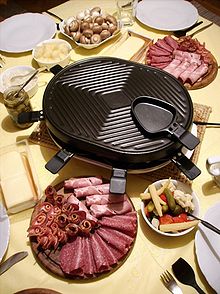
2) I am also a huge fan of Raclette. Raclette is one of those hands-on type dishes (much like hot-pot or fondue or Mongolian bbq aka one of my favorite things) that involves melting cheese and pouring it over potatoes. Sounds like it couldn't get better? Well then you get to grill different kinds of meat (like salami, prosciutto, etc)and put that on top.
This makes it look very technical and complicated but I swear this is good, clean, delicious fun!
3) Praluline from Pralus. This is a type of bread that I was introduced to last night that is specific to this bakery in Paris (Pralus) that is conveniently right around the corner from my apartment. It's essentially a challah-type bread with pink pralines mixed in (and of course a lot of butter) and it is to die for. Amazing served warm or cool, and I think this might be one of the best breads I've had while here in France.
Is that bread or...heaven?!
4) Salade de Chevre-Chaud. This might be my all-time favorite french meal. It's a salad served with slices of warn goat cheese on toast drizzled with honey and balsamic vinegar dressing. There were a couple days at the beginning of my stay where I had this at every meal. Every day. It's that good.
A very simple Salade de Chevre Chaud...but delicious nonetheless.
 5) Moelleux au Chocolat. This is essentially the french version of the chocolate lava cake. It can also go by the alias of "Fondant au Chocolat" or "Mi-cuit" (which means half cooked). Imagine a brownie filled with brownie batter, then warm. Are you dying yet? It's definitely my favorite dessert in France, and while I've tried many from many bakeries and restaurants all around, I have to say that Monoprix makes a dang good one for 2 euros and when heated up in the microwave it's just as good as any fancy one from an expensive store.
This picture conveys about 1/100th the actual deliciousness.
So, that's my attempt at a summary of my favorite foods here! Of course there are others and I could write pages about the amazing meals I've eaten, but I feel so lucky to be studying abroad in a country where the food is good and an important part of life. In fact, this week I'm having my friends over to eat some Ratatouille -- I got a really easy recipe from one of our program directors and have decided to try and make it this week to see what happens! I think I'll probably serve it with quinoa and a fresh baguette and goat cheese, and assuming I don't mess up the recipe TOO much, maybe I'll still have friends by the end of the night!

Thursday, November 24, 2011

Polyglotte

Une polyglotte is the french word for someone who speaks more than 2 languages. Being in France and working on  my french has made me realize how important it is to me that I learn as many languages as I can -- I love studying them and I really believe in the importance of being able to communicate and being a world citizen. Also, it's just interesting! Today my friend invited me to a lecture at the American University in Paris to listen to a presentation by a man who is a scholar/translator of Samuel Beckett. Now, I'm in a class right now and we've read two plays by Beckett - En attendant Godot (I'm sure you can guess that one) and Fin de Partie (Endgame). When I first saw those plays on our reading list, I have to say I was a little disappointed. I'd never read either of them before the class, and I was a little bummed to be reading plays that were written in English in French, as 1) I'm sure to not understand them as well and 2) that's not the original language the author wrote them in. BUT I WAS WRONG! Samuel Beckett originally wrote both of those plays in French, and then only later after they were successful did he translate them into English. Who knew? I mean, another great thing about learning languages is that it really opens up the realm of literature that is available to you, because there really is nothing like reading "Le Petit Prince" in French, or any of the other various books/plays, etc that have been translated from French into English.
Just some random pictures of this beautiful city.
Anyway, so this lecture today was fascinating. Here's the summary that was posted on the website, just to give you a general idea of the topic: At the invitation of the Center for Writers & Translators and the Masters in Cultural Translation, André Topia will speak of his experience of translating Volume I of The Letters of Samuel Beckett into French for forthcoming publication by Gallimard. “Horrible langue que je sais encore trop bien” is how Beckett described his own native language, English, in which he was finding it hard to write. In fact, our professor had told us that Beckett strongly believed that literature should be written in a language other than one's native tongue. He felt that you never really "hear" your native language any more, and so lose some of the nuances and poetry that make it great. All this combined with the problem of then translating his works back into English..and then this lecture guy's job is translating Beckett's personal correspondence into French! Needless to say, I was very excited to go.
The AUP center is located behind an old church in the 7eme, and I got there a bit early and waited for my friend. It was held in a small room around a table, which made for a really nice, intimate setting...although let's be honest so did the delicious free quiche and cookies. Anyway, so the man introduced himself and pretty much just started talking about the topic. It turns out that Beckett knew a lot of languages and loved using each of them to manipulate what he wanted to say. He wrote in German, Italian, French (and various french dialects) and English. His letters to people are filled with really obscure words and some that he's even made up to suit his own purposes -- like "kranky" -- which apparently takes the k from German to make a word that means essentially the English "cranky" but with more anger. So, the more the man explained his job the more complicated it started sounding...it was basically his job to take everything Beckett wrote privately and translate it into a language he (Beckett) deliberately did not choose to write in. M. Topia also discussed a bit the differences between English and French, which were really interesting to hear coming from someone who's an expert on the topic. Apparently, English is a much more nuanced, poetic, and subtle language -- you can say anything at least two different ways in English -- which he explained is due to the way the English language was formed -- half of our words come from the Anglo-Saxon languages of before 1066, while the other half come from French and Latin words that were brought over after the Norman invasion. French, on the other hand, is very repetitive and a lot of English terms don't translate (let alone Beckett's terms). M. Topia used the example of "editor." The french don't make a distinction between the words "editor" and "publisher", and so when Beckett talks about his editors in his letters, it's the translator's job to figure out exactly what to do with that. The whole thing seems like kind of an impossible job to me, but also one that I imagine would be very mentally stimulating and puzzle-like, at times.
Nothing to do with the post, but still a good shot.
The most fascinating part, though, was hearing Topia discuss the differences between the French and English languages. I struggle all the time with "translating" what I want to say in English into French because there are so many expressive subtleties that can't be translated. Also, being someone who has a fairly extensive vocabulary (I don't mean to brag but you know I get those Word of the Day emails yuppp) it gets difficult to express exactly what I want to say (in the English sense) in the French sense. I've definitely learned while here to rely less on thinking of what I want to say in English and then translating it in my head into French and more on just thinking in French. Topia also used the example of the word "quip." There is no french equivalent, and that just shocks me! So then if I wanted to say that someone "quipped wittily", I wouldn't be able to in that exact sense. So I'd have to change what I wanted to say which changes how I communicate with someone. I guess I had never really though about the inability of things to be translated before, and how crazy it is that our native language affects us so much. Honestly, the whole thing kind of vindicated my feelings about how hard it is to learn French (or any language!) and brought up a ton of questions about translating things in general. How difficult! (Thank god for people like M. Topia). And just think of how that translates (haha) to our world and communication between people who speak different languages...it blows my mind. And all because of some Irish author who thought English was too "easy."

Saturday, November 19, 2011

Montparnasse

The courtyard of Reid Hall
I am really lucky that my program center is located in the the center of Paris -- at the bottom of the 5th arrondissement in a neighborhood called Montparnasse. Montparnasse is perhaps most well known for being the home of most (if not all) of the artists who lived in Paris during the 1920s. In French, these years all called "Les Annees Folles" -- the crazy years -- our equivalent of the term "Roaring 20s." Anyways, my program center is located in a building called Reid Hall (yep also my dad's name - Hi dad!) which is on the rue de Chevreuse right off the boulevard de Montparnasse. Reid Hall used to be a French duke's hunting home, because back in the day it sat right on the outskirts of Paris next to the Bois de Boulogrne, a big forest. Now, of course, it's pretty much the center of the Rive Gauche (left bank) lifestyle, but it's heyday was most certainly the 1920s. Pretty much everyone from Picasso to Man Ray to Hemingway to Gertrude Stein lived in this neighborhood, and just walking around you can look up at walls and see plaques saying things like "This was the home of Andre Breton" (founder of Surrealism) or "Here lived Pablo Picasso." Pretty neat. Near the beginning of the semester, I read Hemingway's A Movable Feast and although I love Hemingway, I found the book even more interesting because he would talk about street names I knew and walked down every day! He talked about the four famous cafes - Le Dome, La Coupole, Le Rotund, and Le Select that surround the Vavin metro station and were where all those famous artists went to discuss their work, and the Closerie des Lilas which was his favorite cafe -- one I walk by every day! It was so neat to be able to read this book and understand all of the references he was making and all of the places he was naming.
The grave of Simone de Beauvoir and Jean Paul Sartre in the Montparnasse Cemetary

Picasso's first studio in Paris
My French class here has been loosely structured around the history and culture of Montparnasse during the 20s and each person had to do a 30 minute oral presentation about one of the artists of that time who lived in the neighborhood. Mine was on Man Ray, the famous American photographer who did "The Ingres Violin" and who's muse was Kiki de Montparnasse, the famous singer/dancer/artist's model who ruled the area during that time. Some other ones were Alberto Giacometti, Guillaume Apollinaire, Jean Cocteau, and Josephine Baker. Our teacher (this hilarious, tiny Parisienne) is really passionate and knowledgeable about the subject and took us on a walk of the neighborhood today to point out some of the interesting/historical sights. We started at La Coupole -- one of the famous cafes where these artistic greats came to talk, write, and eat great food. We got coffee and took a tour around the art-deco interior, with original paintings done by the famous artists still on the pillars. We continued on to the Montparnasse Cemetary where Man Ray, Samuel Beckett, Charles Baudelaire, Marguerite Duras and many others a buried, and then walked around and looked at artist's studios (including Picasso's first one!) and the buildings where Man Ray, Tristan Tsara, and Rainer Maria Rilke lived. It was so cool to be taken around by someone who knows the area and all of its secrets! Mme Ricci (our teacher) was also really good about casually waiting outside these famous buildings until someone with the code to get in or out would pass through, and then we would pounce on the open door and walk in to the courtyard to get a better look! Apparently one day she waited outside Picasso's studio for four hours until someone with the code walked in -- she looked over his shoulder and got the code and now, voila! access to Picasso's studio. Love it.

The Tour de Montparnasse - half covered by fog on a cloudy day.
Anyway, Montparnasse is such a fascinating neighborhood, and I'm so lucky that I get to go there practically every day. It's a surreal feeling to be walking around knowing that famous artists and writers and thinkers walked these same streets and saw these same buildings every day. Granted, the neighborhood has definitely cahnged since the 20s - there's a train station now and Western Europe's largest skyscraper -- the Tour de Montparnasse. It's an ugly thing, alright, but you can go up to the top of it (it's something like 200m tall) and get an amazing view of Paris. Well worth the 8 euros it cost to go up!
The amazing view of Paris from the top of the Tour de Montparnasse!

Sunday, November 13, 2011

Dithyrambique

Une dithyrambique is the french word for a long, elegiac speech. It's the title of this post because it's been awhile since I last posted and I want to update everyone on what's been happening. Essentially, I've been very, very busy. Schoolwork combined with trips and visitors to Paris has made these last couple weeks completely insane, but a good kind of insane. It's always fun getting to take trips and see new places, and I also love it when people come to Paris and I get to show them around this amazing city. In doing the traveling that I have been doing (visiting friends on their various study-abroad programs in Prague and London) I've gotten a chance (actually, two chances) to see other programs, other cities, and how other people approach study abroad. It's been fascinating! It has made me realize how well I know Paris and how comfortable I feel in this city -- I can get anywhere I need to be on a daily basis without a problem, and if someone gives me an address I don't know, I can usually get myself at least to that neighborhood without a map. I walk everywhere in Paris, for four reasons. One is that the first day of orientation my program handed out "Pass Navigos" to everyone, which is essentially like a frequent user card that you stock up at the beginning of the month and use to take public transportation everywhere. Except for some reason they were three short and so (of course) me and two other people didn't get them. They made it seem like it would be no problem to just hop into the nearest metro station and get one (it's free), but I was jetlagged and sick of French bureaucracy and you couldn't do it at the metro station near my apartment so I was just like, "Whatever, I'll figure this out another time." Anddd I just never did...So while that reason may be out of laziness, the other three are legit. The first being that I don't want to be 300 pounds from eating French food and walking keeps me in shape, and the second is that a monthly pass is expensive and I'd rather spend that money on, say, food. Or clothes. And the last reason is that walking is the best way to see the city and get a sense of it. It's honestly been the best thing for allowing me to get acquainted with the city because I get to explore different neighborhoods on the way to different events, I get to see streets and different times and in different conditions (yes, I walk even when it's raining - that's what rainboots are for!) and I get to feel like I'm a part of the city. Sometimes it's annoying because it takes me 40 minutes to get to class, but at the end of the day I'm always happy I walked when I could have taken the metro, not least because it's frequently late/really hot or the frenchies are striking (comme d'habitude - like always).
A guy doing tricks with a soccer ball on top of a lamp post in Montmartre. Only in Paris.

Yeah, I live here.
Anyways, besides giving me the opportunity to congratulate myself on how well I know the city, having friends here also gives me a chance to fall in love with Paris all over again. Watching them sit down to eat their first french meal at an adorable local restaurant or bite into their first crepe on the street or watching their faces when they are face-to-face with Notre Dame is always so rewarding! I love watching people fall in love with this place. Recently, my dear friend Ali came and visited me -- she's doing a Fullbright teaching English in Turkey for the year. I had been bugging her to come visit me because I really wanted to see her, and while we were talking about buying tickets she said, "You know Hannah, Paris just isn't on my list of top destinations to go to." I WAS SHOCKED. Who doesn't want to go to Paris? There are frustrated middle-aged housewives all over the US who would die for a chance to come to the most romantic city in the world and gourmands across the world who would kill to eat the food I eat every day. But Ali being Ali, she'd rather go hiking in Jordan or see the Nile River. And not that those aren't things I want to do as well, but Paris is Paris. Ali continued the sentence with saying how much she wanted to see me and what an amazing experience it would be to see Paris with someone who knows the city, but after hearing about her initial hesitance I was determined to show her Paris in all it's glory. And I did, because honestly, who can resist Paris? Try and try as one might, I think Ali fell for it somewhere between her first macaron and hot chocolate at Angelina -- so thick it's like drinking liquid fudge. That combined with exploring the Musee D'Orsay and the Eiffel Tower at night and I think the girl was hooked. Upon leaving she told me Paris was "incredible" and "magical" and that she never thought she'd fall in love with it the way she did. I told her I knew she would because honestly, we all have.
Ali in front of Val de Grace - loving every minute of it!